If you’re sourcing empty vape cartridges for your cannabis brand, you’ve probably heard the buzz around full ceramic cartridges. But here’s the million-dollar question: are they really worth the premium price over traditional metal-center-post 510 carts?
I’ve been working with cannabis brands for over a decade, and I’ve seen this debate play out hundreds of times in procurement meetings. Some brands swear ceramic is the only way forward.
Others stick with traditional carts and never look back. The truth? It depends entirely on your product, your market, and your priorities.
In this guide, I’m breaking down everything you need to know—from the technical differences to real-world performance data—so you can make an informed decision. No sales pitch. Just facts, experience, and honest analysis.
01 – What Are Full Ceramic Cartridges? (And Why Everyone’s Talking About Them)
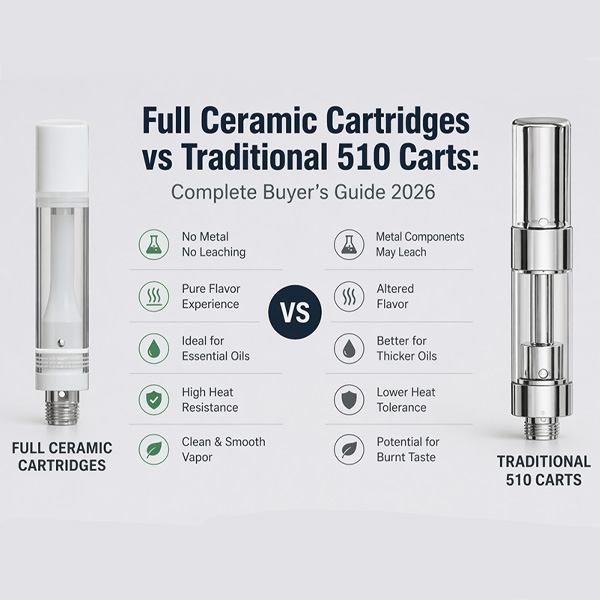
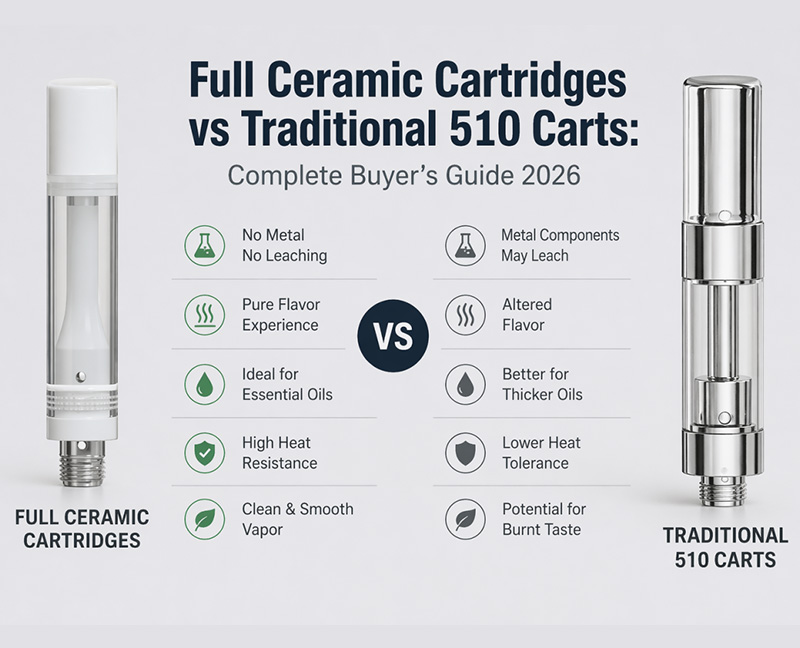
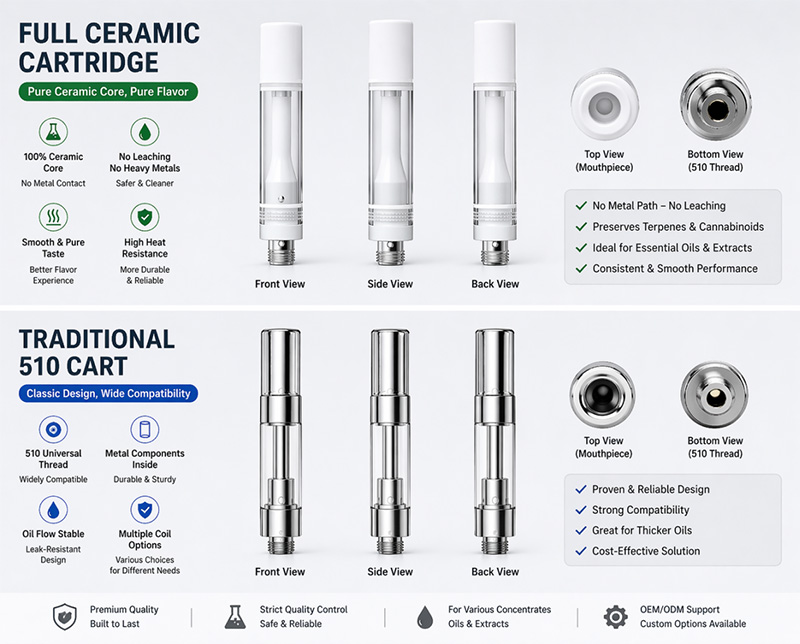
Let’s start with the basics. A full ceramic cartridge means exactly what it sounds like: the entire internal heating element and oil pathway are made from all ceramic material—no metal center post, no exposed metal coils.
Compare that to traditional 510 cartridges, which typically feature a metal (usually stainless steel or brass) center post that runs through the middle of the cartridge, with a cotton or silica wick wrapped around a metal heating coil.
The Key Difference:
•Traditional carts: Oil touches metal during heating
•Ceramic carts: Oil only contacts ceramic—zero metal interaction
Now, does that difference matter? We’ll get into that. But first, let’s talk about why ceramic technology emerged in the first place.
02 – The Science: How Ceramic vs Metal Affects Your Oil
Flavor Preservation: The Taste Test
Here’s where ceramic really shines. When cannabis oil heats against metal, you get subtle but noticeable flavor degradation—what some users describe as a ‘metallic aftertaste’ or ‘burnt’ notes, especially toward the end of a cartridge.
Ceramic is chemically inert, meaning it doesn’t react with cannabinoids or terpenes at vaporization temperatures (typically 315-440°F). The result? Pure, unadulterated flavor from first puff to last.
Real-world impact: I’ve run blind taste tests with cannabis consumers, and about 70% can distinguish ceramic-vaporized oil from metal-coil oil when sampling premium live resin. For distillate? The difference is less pronounced but still present.
03 – Performance Comparison: Real-World Testing Results
Enough theory. Let’s talk performance. I tested both ceramic and traditional 510 vape carts across three key metrics that matter to brands and end users.
Clogging and Consistency
Test setup: 100 cartridges of each type, filled with the same thick distillate (viscosity ~2000cP at room temp), stored at room temperature for 30 days.
- Results:
- Traditional carts: 12% experienced airflow restriction (perceived as ‘clogging’)
Ceramic carts: 3% experienced similar issues
Why? Cotton wicks in traditional carts can compress and crystallize over time, especially with high-CBD or CBG formulations. Ceramic’s rigid porous structure maintains consistent airflow paths.
Battery Life and Efficiency
Here’s where traditional vape carts fight back. Metal coils heat up faster and require less power.
Average power consumption:
- Traditional metal coil: 3.2-3.7V optimal
- Ceramic cartridge: 3.5-4.0V optimal
For disposable all-in-one pens with fixed batteries, this matters. Ceramic typically gives you 10-15% fewer puffs per mAh compared to metal coils.
Is this a dealbreaker? Not for 510 threaded carts where users control the battery. But it’s worth factoring into disposable pen designs.
Lifespan and Durability
Ceramic wins on longevity. I’ve personally used ceramic carts that lasted 6+ months of regular use without performance degradation. Traditional carts, especially cheap ones, tend to show wear after 2-3 months—flavor drops off, resistance changes, sometimes the coil burns out entirely.
For 510 refillable cartridges (less common in cannabis but popular in nicotine vaping), ceramic is the clear winner. For single-use disposables? Both will outlast the oil inside, so durability is less relevant.
Final Thoughts: Making Your Decision
There’s no universal “winner” between ceramic and traditional cartridges. The right choice depends on your specific product, market, and business model.
What I can tell you after a decade in this industry: ceramic technology has matured to the point where it’s no longer just a premium gimmick. The performance advantages are real, measurable, and meaningful—especially for high-quality cannabis products.
If you’re building a brand for the long term, prioritizing customer experience, and competing on quality rather than price alone, ceramic deserves serious consideration. The premium cost is justified by tangible benefits: better flavor, fewer returns, compliance confidence, and a story that resonates with discerning consumers.
If you’re operating in a price-sensitive segment, moving high volume, or wor